,000 of gross pay typically goes" />
,000 of gross pay typically goes" />
Comprehensive Free Paycheck Tool
Why Is My Paycheck So Small?
Enter your salary and state to see a complete visual breakdown of every deduction — in plain English, not tax jargon.
Federal income taxFICA explainedState tax by stateBenefits deductionsTake-home pay
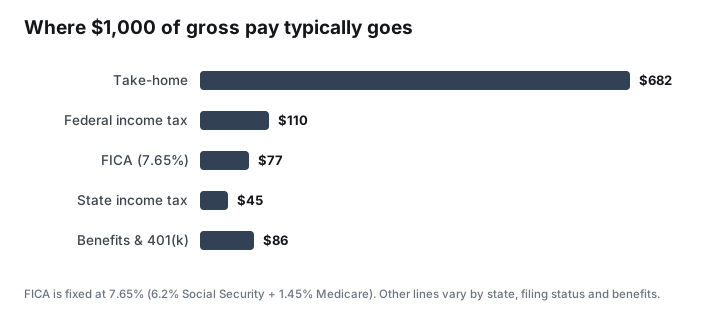
FICA alone takes 7.65% of gross pay before any income tax applies. Most of the gap between salary and take-home is these stacked deductions, not one big one.
Paycheck Deductions Calculator
Most people are surprised by how much less they take home compared to their salary. This calculator shows every deduction in plain English — what it is, why you pay it, and how much it costs you each paycheck and each year.
Pre-tax benefit deductions per paycheck (optional)
$
$
$
$
Your take-home pay
—
per paycheck
—Annual take-home
—Effective tax rate
—% kept
Where your gross pay goes
—take home
📊 Annual paycheck breakdown
Every dollar of your gross salary, allocated across the full year.
📖 What each deduction actually means
Federal taxes
Federal income tax is the largest deduction for most workers. The U.S. uses a progressive bracket system — you don't pay your top rate on all income. Each dollar is taxed at progressively higher rates as your income climbs through brackets. Your marginal rate is the rate on your last dollar earned; your effective rate is what you actually pay as a percentage of total income. These are almost always different numbers.
FICA (Social Security + Medicare) stands for Federal Insurance Contributions Act. Social Security is taxed at 6.2% of wages up to an annual wage base (set by the IRS each year and adjusted for inflation). Medicare is taxed at 1.45% on all wages, with an additional 0.9% surcharge on high earners. Your employer matches these contributions dollar-for-dollar — so the combined employer + employee FICA contribution is 15.3% of your wages.
State & local taxes
Nine states have no income tax: Alaska, Florida, Nevada, New Hampshire, South Dakota, Tennessee, Texas, Washington, and Wyoming. The remaining states have rates ranging from a flat 3–5% to progressive brackets that can exceed 13% (California). Some cities and counties also levy local income taxes on top of state taxes — common in New York City, Philadelphia, and many Ohio cities.
Pre-tax deductions — the good kind
401(k) / 403(b)
Contributions reduce your taxable income dollar-for-dollar. A $6,000 annual contribution at a 22% marginal rate saves you $1,320 in federal taxes that year. Subject to annual IRS contribution limits.
Health insurance premium
Employer-sponsored health insurance premiums paid through payroll are typically pre-tax, reducing both your income tax and FICA tax — a double benefit that individual market premiums don't offer.
HSA (Health Savings Account)
Triple tax advantage: contributions are pre-tax, growth is tax-free, and withdrawals for qualified medical expenses are tax-free. Only available with high-deductible health plans (HDHPs).
FSA (Flexible Spending Account)
Pre-tax contributions for medical or dependent care expenses. Unlike an HSA, FSA funds generally must be used within the plan year (some plans allow a small rollover or grace period).
Your W-4 and withholding
Your W-4 controls how much federal tax is withheld — not how much you owe. If too little is withheld, you'll owe money at tax time (plus potential penalties). If too much is withheld, you get a refund — but you've effectively given the government an interest-free loan. The IRS withholding estimator at irs.gov helps you dial in the right amount for your situation.
📈 How take-home pay scales by salary
Estimated bi-weekly take-home for a single filer in a no-income-tax state. Actual amounts vary by state, filing status, and deductions.
Annual salary
Gross / bi-weekly
Est. take-home
Effective rate
% kept
Estimates use current federal brackets for a single filer with standard deduction. State tax not included. For personalized results, use the calculator above.
Understanding your paycheck — the basics
The gap between your salary and your take-home pay surprises almost everyone who sees their first paycheck. A $65,000 salary does not mean $65,000 in your bank account each year — it means $65,000 in gross pay before taxes and deductions. For most middle-income earners, take-home pay is 68–78% of gross salary depending on state, filing status, and benefit elections.
The three largest deductions for most workers are federal income tax, Social Security (6.2%), and Medicare (1.45%). Together, FICA taxes alone remove 7.65% from every dollar you earn before federal and state income taxes are even calculated. Understanding this helps you make smarter decisions about retirement contributions, benefit elections, and W-4 withholding.
The most powerful lever you control: pre-tax deductions. Every dollar contributed to a 401(k), HSA, or FSA reduces your taxable income — lowering both your income tax and, for some deductions, your FICA taxes. A worker in the 22% federal bracket who contributes $10,000 to their 401(k) saves $2,200 in federal taxes alone that year. The contribution costs them significantly less than $10,000 in actual take-home pay.
💼 Employer Match Calculator — Are You Leaving Free Money on the Table?
The employer 401(k) match is the closest thing to free money in the American compensation system — yet roughly 1 in 5 employees who receive a match don't contribute enough to capture all of it. Enter your details to see exactly what you're getting (or missing).
$
%
%
%
—Your contribution/yr
—Employer match/yr
—Uncaptured match/yr
—Total going in/yr
Your contribution
—
Employer match
—
Uncaptured match
—
📊 Employer-Sponsored Investment Accounts — Side by Side
Every account type has different rules, tax treatment, and eligibility. Here's what each one means for your paycheck and your retirement.
Traditional 401(k)
Tax treatmentPre-tax contributions, taxed on withdrawal
Paycheck impactReduces taxable income immediately
Contribution limitIRS annual limit (see IRS.gov for current limit)
Employer matchYes — most common match vehicle
Early withdrawal10% penalty + income tax before age 59½
Best forThose who expect lower tax rate in retirement
Contribution limitSame IRS limit as traditional 401(k)
Employer matchYes — match goes into traditional 401(k)
Early withdrawalContributions anytime; earnings: 59½ rule applies
Best forThose who expect higher tax rate in retirement
403(b)
Who it's forNon-profits, schools, hospitals, government
Tax treatmentSame as 401(k) — traditional or Roth options
Contribution limitSame IRS limit as 401(k)
Employer matchSometimes — varies by employer
Special feature15-year catch-up for long-term employees
Best forPublic sector and non-profit employees
SIMPLE IRA
Who it's forSmall businesses (under 100 employees)
Tax treatmentPre-tax contributions, taxed on withdrawal
Contribution limitLower than 401(k) — see IRS.gov annually
Employer matchRequired — either 2% or 3% match options
Early withdrawal25% penalty in first 2 years; 10% after
Best forSmall business employees — match is mandatory
SEP-IRA
Who it's forSelf-employed, freelancers, small business owners
Tax treatmentPre-tax; employer contributions only
Contribution limitUp to 25% of compensation — high ceiling
Employee contributionsNot allowed — employer only
Early withdrawal10% penalty + income tax before 59½
Best forHigh-earning self-employed individuals
457(b)
Who it's forState/local government and some non-profit employees
Tax treatmentPre-tax; Roth option available in some plans
Contribution limitSame as 401(k) — can stack with 403(b)
Unique featureNo 10% early withdrawal penalty — any age
Employer matchRare in government plans
Best forGovernment workers — especially near retirement
Contribution limits change annually. The IRS adjusts 401(k), IRA, HSA, and FSA contribution limits each year, typically in the fall for the following tax year. Always verify current limits at IRS.gov before making contribution decisions.
🤝 Profit Sharing — How It Works & How It's Taxed
Profit sharing is an employer-funded retirement benefit — unlike a 401(k) match, it's not tied to your contributions. Your employer puts money into a profit-sharing account on your behalf, typically as a percentage of your annual salary, when the company hits profit targets. Here's what you need to know.
How it appears on your pay
Profit sharing contributions typically don't appear on regular paychecks. They're usually deposited annually (or quarterly) directly into your retirement account. You may see it on a year-end statement but not in your biweekly pay stub.
How it's taxed
Profit sharing contributions are pre-tax (like a traditional 401(k)) and count toward the total annual additions limit set by the IRS. You don't pay income tax on them now — you pay when you withdraw in retirement. FICA taxes are not owed on employer profit-sharing contributions.
Vesting schedules
Most profit-sharing plans have a vesting schedule — meaning you don't own 100% of the employer's contributions until you've worked a certain number of years. Leaving before fully vested means forfeiting unvested funds.
Discretionary nature
Unlike a 401(k) match, profit sharing is discretionary — the employer is not legally required to make contributions every year. In a down year, contributions may be reduced or eliminated entirely. Don't build retirement projections around profit sharing as a guaranteed amount.
Typical vesting schedules — graded vs cliff
Graded vesting (most common)
Year 1
0%
Year 2
20%
Year 3
40%
Year 4
60%
Year 5
80%
Year 6
100%
Cliff vesting
Year 1
0%
Year 2
0%
Year 3
100%
Year 4+
100%
With cliff vesting, you own 0% until the cliff date — then 100% instantly. Leaving one day before the cliff means forfeiting all employer contributions.
Job change tip: Always check your vesting schedule before accepting a new job offer or resigning. Leaving just before a vesting anniversary can cost thousands in forfeited employer contributions. If you're within 6–12 months of a vesting milestone, it may be worth negotiating your start date or factoring the unvested amount into a signing bonus request.
Frequently asked questions
What happens to my 401(k) if I leave my job? ▼
You have four options: (1) Leave it with your former employer's plan — fine if the plan has good investment options and low fees. (2) Roll it over to your new employer's 401(k) — consolidates accounts and keeps investing. (3) Roll it over to an IRA — often the most flexible option with the widest investment choices. (4) Cash it out — almost always the worst option: you'll owe income tax on the full amount plus a 10% early withdrawal penalty if you're under 59½. Always do a direct rollover (check made out to the new institution, not to you) to avoid mandatory 20% withholding.
How does an employer 401(k) match work? ▼
An employer match means your company contributes money to your 401(k) based on how much you contribute. The most common formula is "50% match up to 6% of salary" — meaning if you contribute 6% of your salary, your employer adds another 3% (50% of your 6%). To get the full match you must contribute at least the match threshold. Contributing less leaves free money uncaptured. Some employers offer a dollar-for-dollar match up to a lower cap. Always contribute at least enough to capture the full employer match — it's an immediate 50–100% return on that portion of your money before any investment gains.
Is profit sharing the same as a bonus? ▼
No — they're taxed and structured differently. A cash bonus is paid directly to you as income, subject to federal and state income tax and FICA taxes, and shows up on your paycheck. Profit sharing contributions go directly into a retirement account (usually your 401(k) or a separate profit-sharing account) pre-tax. You don't pay taxes until withdrawal. This makes profit sharing significantly more valuable per dollar than a cash bonus of the same amount — though the tradeoff is that the money is locked up until retirement (subject to early withdrawal penalties). Some companies offer both programs simultaneously.
Why is my paycheck less than my salary divided by 26? ▼
Your salary is your gross (before-tax) annual pay. Your paycheck is your net (after-tax) pay for that period. The difference is made up of federal income tax, FICA taxes (Social Security + Medicare), state income tax, and any pre-tax benefit deductions you've elected. For most workers, these deductions total 22–32% of gross pay, which is why take-home pay is significantly lower than the math on your salary suggests.
What is FICA and why do I have to pay it? ▼
FICA stands for Federal Insurance Contributions Act. It funds two programs: Social Security (6.2% of wages, up to the annual wage base) and Medicare (1.45% on all wages). These aren't optional deductions — they're mandatory federal taxes regardless of your filing status or W-4 settings. Your employer also pays an equal amount on your behalf (they match your 6.2% Social Security and 1.45% Medicare contributions). High earners pay an additional 0.9% Medicare surtax on wages above a threshold set by the IRS.
What's the difference between marginal and effective tax rate? ▼
Your marginal tax rate is the rate applied to the last dollar you earn — the highest bracket you've reached. Your effective tax rate is the total federal income tax you pay divided by your total gross income. Because the U.S. uses a progressive bracket system, your effective rate is always lower than your marginal rate. For example, a single filer earning $80,000 is in the 22% marginal bracket, but their effective federal tax rate is typically around 13–14% because the first dollars of income are taxed at lower rates (10% and 12%). Knowing the difference is important — "I'm in the 22% bracket" doesn't mean 22% of your total income goes to federal tax.
How do I adjust my withholding to stop owing money at tax time? ▼
File a new W-4 with your employer. The IRS redesigned the W-4 form to make withholding more accurate — it no longer uses allowances. Use the IRS Tax Withholding Estimator (irs.gov) to calculate the exact additional withholding amount needed per pay period, then enter that dollar amount in Step 4(c) of your W-4. Common reasons people owe at tax time: multiple jobs in the household, significant freelance or 1099 income, investment gains, or not updating W-4 after a major life change (marriage, divorce, new dependent).
Does contributing to a 401(k) actually reduce my taxes? ▼
Yes — traditional 401(k) contributions are pre-tax, meaning they reduce your taxable income dollar-for-dollar in the year you contribute. If you earn $70,000 and contribute $7,000, you're only taxed on $63,000 in federal income. At a 22% marginal rate, that saves $1,540 in federal taxes. You still pay FICA on the full salary, and you'll pay income tax on withdrawals in retirement — but typically at a lower rate than during your working years. Roth 401(k) contributions work differently: they're post-tax, so they don't reduce current taxable income, but withdrawals in retirement are completely tax-free.
Which states have no income tax? ▼
Nine states currently have no individual income tax: Alaska, Florida, Nevada, New Hampshire, South Dakota, Tennessee, Texas, Washington, and Wyoming. Note that New Hampshire taxes interest and dividend income, though not wages. Living in a no-income-tax state can be a meaningful take-home advantage — a worker earning $80,000 in California (where top state rates exceed 9%) vs. Texas (no state income tax) may keep several thousand dollars more per year. However, states without income taxes often make up revenue through higher property taxes, sales taxes, or other fees.
What happens to Social Security taxes I pay? ▼
Social Security taxes you pay today don't go into a personal account — they fund current retirees' benefits. When you retire, your benefits are calculated based on your 35 highest-earning years of Social Security-taxed income. The more you earn (up to the annual wage base), the higher your eventual Social Security benefit. You can estimate your projected benefits at any age using the Social Security Administration's online estimator at ssa.gov. Full retirement age for most current workers is 67, though you can claim as early as 62 (at a reduced benefit) or delay until 70 (for a higher monthly payment).
🛡️ Premiums are the biggest non-tax line on your stub
After taxes, insurance premiums are usually the largest deduction on a paycheck. Knowing what each one actually buys — and which are pre-tax — is the first step to shrinking the gap between salary and take-home.
Some links above are partner links. Where a partner relationship exists we may earn a referral fee at no additional cost to you — it never changes which providers we show or what the calculator tells you.